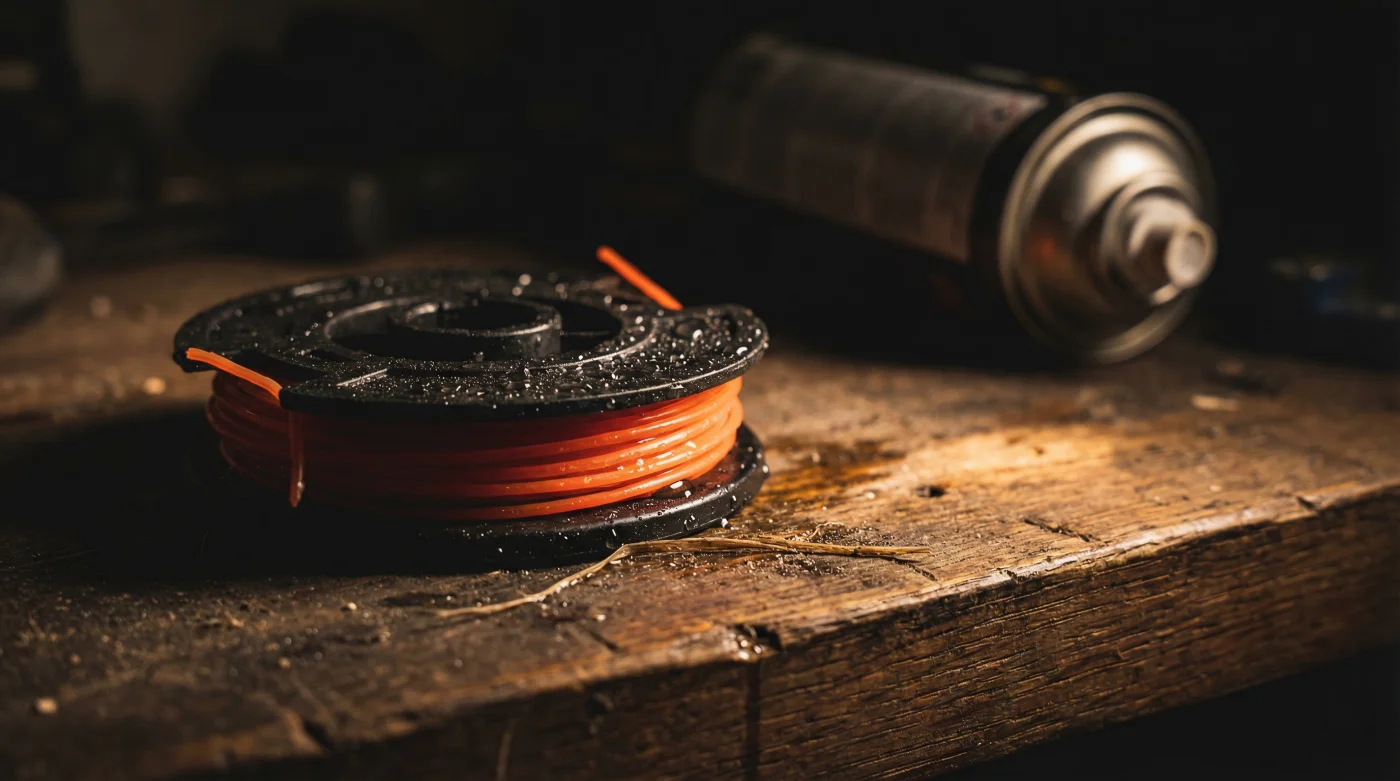
You know the exact physical sensation. The 90-degree Fahrenheit midday heat is pressing down on your shoulders, the smell of sheared crabgrass hangs thick in the humid air, and the engine of your string trimmer is purring in your hands. You are completely locked into the rhythm of the work, sweeping along the jagged edge of the concrete driveway, watching the overgrown weeds disappear into a fine green mist.
Then comes that familiar, hollow whir. A sudden lack of resistance against the grass. The line has snapped, retreating deep into the plastic housing. The rhythm dies instantly, replaced by the heavy silence of an idle motor. You sit down on the sun-baked concrete, pry off the dirt-caked spool cap, and find a disaster.
Inside the housing, the bright neon plastic isn’t just tangled. It looks like it has been fused together. Generational yard-care lore insists that nylon gets brittle as it sits in your hot garage, and that the only fix is soaking the entire spool in a bucket of water overnight to rehydrate the plastic. But you aren’t dealing with a lack of moisture. You are dealing with an invisible enemy.
The professional reality requires an entirely different approach to the physics of the tool. A three-second friction barrier created by a simple can of dry silicone spray changes everything inside that rotating plastic drum. It completely eliminates the midday spool-jam ritual, keeping you on your feet and finishing the job.
The Pressure Cooker Inside the Spool
To understand why the line keeps snapping at the worst possible moment, you have to stop looking at the trimmer head as a simple storage dispenser. When that motor hits full throttle, spinning at thousands of revolutions per minute, that small plastic housing becomes a high-speed centrifuge.
The centrifugal force pulls the line tight against itself. As you feed the string out by bumping the head against the ground, the internal strands aggressively rub against one another. Friction generates intense heat, raising the temperature of the nylon just enough to hit its glass transition phase. The strands lightly spot-weld together. The next time you tap the head, the line is physically glued in place, so the spinning force snaps it off right at the metal eyelet.
Soaking the line in water feels like a logical countermeasure, but the moisture simply evaporates the moment those 8,000 RPMs kick in and the friction begins. By coating the plastic line in a dry silicone spray, you strip the friction out of the equation entirely. The strands simply slip past each other like greased glass, feeding smoothly out of the eyelets without catching, heating, or fusing.
Marcus Thorne, 54, a municipal groundskeeper in Savannah, Georgia, maintains miles of highway medians every week. He has zero patience for water buckets in the sweltering humidity. “We go through literal miles of heavy-duty twisted line a month,” he noted recently while prepping his trailer. “The older guys always told me to leave the bulk spools in water overnight. It’s a total myth. One day I grabbed the dry silicone I use to keep grass off the mower deck chutes, sprayed down a freshly wound trimmer spool, and didn’t have a single jam for six straight miles of chain-link fence.”
Adapting the Lubrication to Your Arsenal
Not all yard vegetation is created equal, and neither is the equipment required to beat it back. Applying the right barrier depends heavily on what sort of machine you are running and what kind of line you spool into it.
For the Heavy-Duty Brush Clearer
If you are fighting through thick stalks, briars, and neglected ditches, you are likely running a gas-powered machine with a heavy-gauge, twisted, or serrated line. These aggressive profiles have sharp edges that bite into vegetation, but those same edges bite into the surrounding line inside the spool, creating massive friction points. Silicone spray is non-negotiable here. A heavy coating allows those jagged edges to slide without interlocking.
For the Cordless Electric Minimalist
- Silicone spray triples string trimmer line lifespan during heavy yard work.
- Corrugated dryer vent hoses cause internal lint fires without routine vacuuming.
- Rough sawn cedar fencing builds premium raised garden beds cheaply.
- Inverted ceiling hooks secure heavy blackout curtains without drywall drilling.
- Coarse kosher salt instantly removes severe cast iron rust layers overnight.
For the Bulk Buyer
Buying massive spools of string trimmer line saves money, but it means the plastic will sit on a shelf in a fluctuating garage environment for years. Every spring, unspool the first ten feet, wipe away the garage dust, and give the entire exterior of the master spool a quick spray. This prevents the outer layers from binding as you pull off what you need for the day.
The Mindful Application Process
Taking control of your equipment’s longevity isn’t about adding another tedious chore to your weekend. It is a five-minute preventative fix that happens at the workbench, long before you ever pull the starter cord. The process requires a clean environment and a deliberate touch.
- Strip the housing: Remove the spool from the trimmer head and discard any mangled, fused fragments of old line. Wipe the inner plastic drum clean with a dry rag to remove grit.
- Wind with tension: Anchor your new line and wind it evenly, keeping a firm, consistent tension. Sloppy, overlapping wraps will still pinch mechanically, even with lubrication.
- Apply the barrier: Once the spool is fully wound, hold it over a piece of cardboard. Apply a continuous, even spray of dry silicone lubricant directly onto the exposed line.
- Let it flash off: Allow the spool to sit for two minutes. The carrier solvents will evaporate, leaving behind a slick, completely dry protective film that won’t attract dirt or grass clippings.
Tactical Toolkit:
- Lubricant: 100% Dry Silicone Spray (avoid WD-40 or oil-based sprays, which degrade plastic and attract dirt).
- Cure time: 2 to 3 minutes at room temperature.
- Line tension: Firm, wrapping side-by-side without crisscrossing.
Reclaiming the Yard Work Rhythm
Mastering this subtle mechanical detail goes far beyond saving a few feet of neon plastic. It is about fundamentally changing your relationship with property maintenance. Yard work shouldn’t be defined by a series of frustrating interruptions.
When you eliminate the friction inside the machine, you protect your own momentum. You get to keep moving, walking the perimeter, finishing the edge of the patio, and smelling the fresh-cut grass without constantly stopping to fight with a piece of melted plastic. You transform a tedious weekend chore into a smooth, satisfying completion of a task.
“Friction is the enemy of all moving parts; control the friction, and the machine will do the hard work for you.”
| Key Point | Detail | Added Value for the Reader |
|---|---|---|
| The Core Problem | Internal line strands spot-weld together due to centrifugal friction and heat. | Saves you from manually untangling and restringing your trimmer head multiple times per session. |
| The Water Myth | Soaking line in water evaporates quickly under 8,000 RPMs and heat. | Prevents wasted overnight prep time on an outdated yard-care trick that doesn’t solve friction. |
| The Solution | Dry silicone spray creates a slick, dry barrier between overlapping plastic lines. | Keeps your workflow uninterrupted and significantly extends the usable life of your bulk line. |
Frequently Asked Questions
Will regular WD-40 work instead of silicone spray? Standard WD-40 is a petroleum-based solvent. It can chemically degrade the nylon over time and will remain wet, attracting dust and dirt that causes more jams. Always use a dedicated dry silicone spray.
Do I spray the inside of the trimmer head or just the line? Spray the wound line directly while it is on the removable spool. A light mist inside the plastic housing won’t hurt, but the goal is to coat the strands so they glide past one another.
How often do I need to reapply the silicone? Apply it once every time you load a fresh spool. The dry film will last until the entire spool of line is depleted.
Will the silicone spray harm my grass or plants? Because dry silicone flashes off and leaves only a microscopic dry film, the trace amounts that touch the edges of your lawn are entirely harmless to vegetation.
Can I spray old, brittle line that has been sitting in my garage? Yes. While it won’t reverse heavy UV damage, the lubrication will still reduce the friction that causes older line to snap prematurely inside the housing.