The weekend sun beats down on the asphalt parking lot as you wheel a flatbed cart through the outdoor aisles of the local garden center. The air smells heavily of dyed mulch, synthetic fertilizer, and melting shrink wrap. You stop in front of a wire basket holding a dozen pale, dusty rocks, trying to calculate how many you need to border your new perennial bed.
They call them decorative landscape boulders, wrapped neatly in wire caging with a glossy barcode stapled to the side. The price tag attached to just one of these fifty-pound stones is enough to make your stomach drop. It feels less like buying a piece of the earth and more like purchasing a luxury appliance.
You assume this is simply what landscaping costs. The garden center tells a silent story of convenience, convincing you that sourcing raw stone requires a heavy premium, specialized knowledge, and a commercial license. You place three stones on your cart, watching seventy dollars vanish for something that literally falls out of the side of a mountain.
But there is a quiet, dusty reality sitting just a few miles outside city limits, completely bypassing the retail illusion entirely. Out there, the earth is sliced open and sold not by the individual shrink-wrapped pound, but by the jagged, heavy ton. When you finally pull your truck onto the gravel scales of a regional stone quarry, you realize that the foundation of your garden has been fiercely marked up.
The Perspective Shift: Funding the Packaging
Purchasing stone at a commercial garden center is exactly like buying flour by the teaspoon. You aren’t actually paying for the material itself. You are paying for the wooden pallet, the thick plastic wrapping, the diesel fuel required to truck it to a retail hub, the store’s overhead, and the glossy marketing label slapped onto the wire cage.
By the time a piece of granite reaches a home improvement store, you are paying for the logistics chain rather than the geological product. Direct quarry purchasing operates on an entirely different economic model. Quarries deal in raw extraction. They blast, they crush, they sort, and they sell to anyone willing to drive over their massive industrial scales.
Arthur Vance knows this discrepancy better than anyone. At fifty-eight, Arthur has spent two decades operating a front-end loader at a limestone quarry in rural Pennsylvania. His days are spent moving massive, jagged slabs of gray rock that shake the ground when they drop into the beds of commercial dump trucks.
Arthur often chuckles when suburban homeowners cautiously pull up to the scale house in a rented pickup truck. They come expecting to pay a fortune, conditioned by garden center pricing. He watches their eyes widen when they realize a load that fills their entire truck bed costs less than a pizza. As Arthur likes to put it, they are just buying dirt’s harder cousin, and dirt is notoriously cheap when you go straight to the source.
Stone Hunting for Every Scale
Stepping into the world of direct quarry buying requires a slight adjustment in how you view materials. You are no longer shopping from a curated shelf; you are foraging in an industrial landscape. Understanding the distinct zones of a quarry allows you to find exactly what you need without paying for sorting you could do yourself.
For the weekend putterer looking to build a small retaining wall or a fire pit surround, the quarry’s scrap pile is your greatest asset. Many quarries maintain a bone yard of irregular shapes, chipped faces, or overstock stones that do not neatly fit onto commercial pallets. These irregular pieces offer the beauty of geological arbitrage, providing organic, natural shapes at a fraction of the cost of uniform blocks.
If you are taking on a heavier landscaping project, such as terracing a sloping yard, you will want to look at bulk-dumped stone versus palletized stone. Palletized stone at a quarry is still vastly cheaper than retail, but it carries a slight premium because a human had to stack it. Bulk stone, piled high by loaders, is sold purely by weight. You simply pick what you want and load it.
For the design purist, visiting a regional quarry means embracing local geology. Rather than importing river rock from three states away, you are utilizing the exact bedrock beneath your feet. In New England, this means fractured granite. In the Midwest, porous limestone. In the Southwest, oxidized sandstone. This creates a landscape that feels inherently grounded and natural to your specific climate.
Navigating the Scale House
Driving into an active quarry can feel intimidating. There are massive trucks, dust plumes, and loud machinery. But the process is remarkably simple once you understand the rhythm of the scale house. You do not need special credentials to buy stone; you just need to follow the established protocol of weighing in and weighing out.
The system relies entirely on tare weight. You drive your empty vehicle onto the massive metal scale at the entrance. The operator records your empty weight. You drive into the yard, load your stones, and drive back onto the scale. The difference is what you pay for. To make this process seamless, keep these mindful steps in play.
- Call ahead to confirm public hours and check if they require high-visibility vests or hard hats on site.
- Bring thick leather gloves; raw quarry stone has sharp, unweathered edges that will shred bare hands.
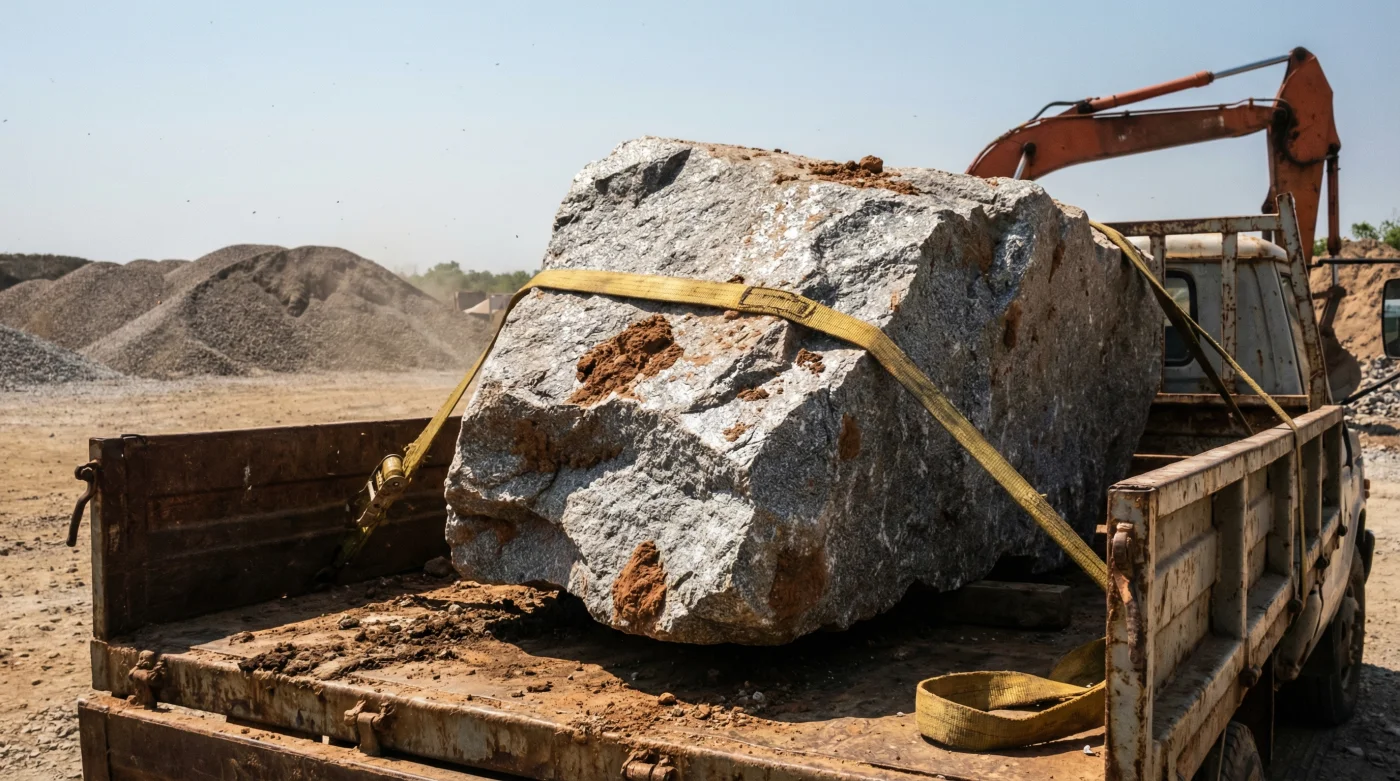
- Pack heavy-duty ratchet straps if you are loading flatbed trailers, ensuring nothing shifts on the highway.
- Ask the scale operator where the residential picking pile is located to avoid blocking commercial dump trucks.
Your tactical toolkit for quarry day is simple: a sturdy vehicle, protective gear, and a clear idea of your carrying capacity. Never exceed your vehicle’s payload rating. Stone is deceptively dense. It is always better to make two safe, cheap trips than to destroy your rear suspension trying to haul a full ton in a standard suburban SUV.
Grounding Your Landscape
Bypassing the massive retail markups of garden centers is a highly satisfying financial victory. Saving hundreds, or even thousands, of dollars on hardscaping frees up your budget for mature plantings, better soil amendments, or quality lighting. But the real value extends far beyond the initial cost savings.
When you hand-select your own boulders straight from the earth that formed them, you change your relationship with your garden. You stop viewing landscape stone as a manufactured product shipped in a cardboard box. Instead, you begin to see it as the skeletal structure of your yard, a quiet, permanent force that anchors your outdoor space.
The dust on your boots and the scratches on your leather gloves become a tangible connection to the work. You aren’t just decorating a flower bed; you are literally moving mountains, one carefully chosen stone at a time, bringing the raw geology of your region right to your own front door.
Sourcing your stone directly from the quarry isn’t just a financial hack; it is a return to the oldest, most authentic form of building with the earth.
| Source | Pricing Model | Your Ultimate Benefit |
|---|---|---|
| Big-Box Garden Center | Per individual stone or small bag | High convenience for tiny projects, but staggering retail markups. |
| Independent Rock Yard | Per wire basket or pallet | Better variety and moderate savings, but you still pay middleman transport fees. |
| Regional Stone Quarry | Per ton (bulk weight) | Pennies on the dollar, authentic local geology, and massive volume capability. |
Quarry Sourcing FAQ
Do I need a commercial account to buy from a local stone quarry?
Rarely. Most regional stone quarries operate a public scale and welcome residential buyers. You simply drive in, weigh your empty vehicle, load your stone, and weigh out.How do I know how much weight my truck or trailer can safely carry?
Check the sticker inside your driver-side door jamb for the payload capacity. Remember that payload includes the weight of the passengers. Stone is incredibly dense, so load conservatively.Will the quarry load the stones into my truck for me?
If you are buying crushed gravel or bulk piles, they will drop it in with a loader. If you are hand-picking decorative landscape boulders, you are entirely responsible for lifting and loading them yourself.Is the stone at a quarry dirtier than what I buy at a store?
Yes. Quarry stone is raw and covered in stone dust from the crushing process. Once placed in your yard, a strong spray from a garden hose will wash the dust away, revealing the true color.Can I find smooth river rock at a standard blasting quarry?
Generally, no. Blasting quarries produce jagged, angular stone. If you want smooth, water-worn boulders, you need to seek out a quarry that specifically dredges or mines ancient riverbeds.