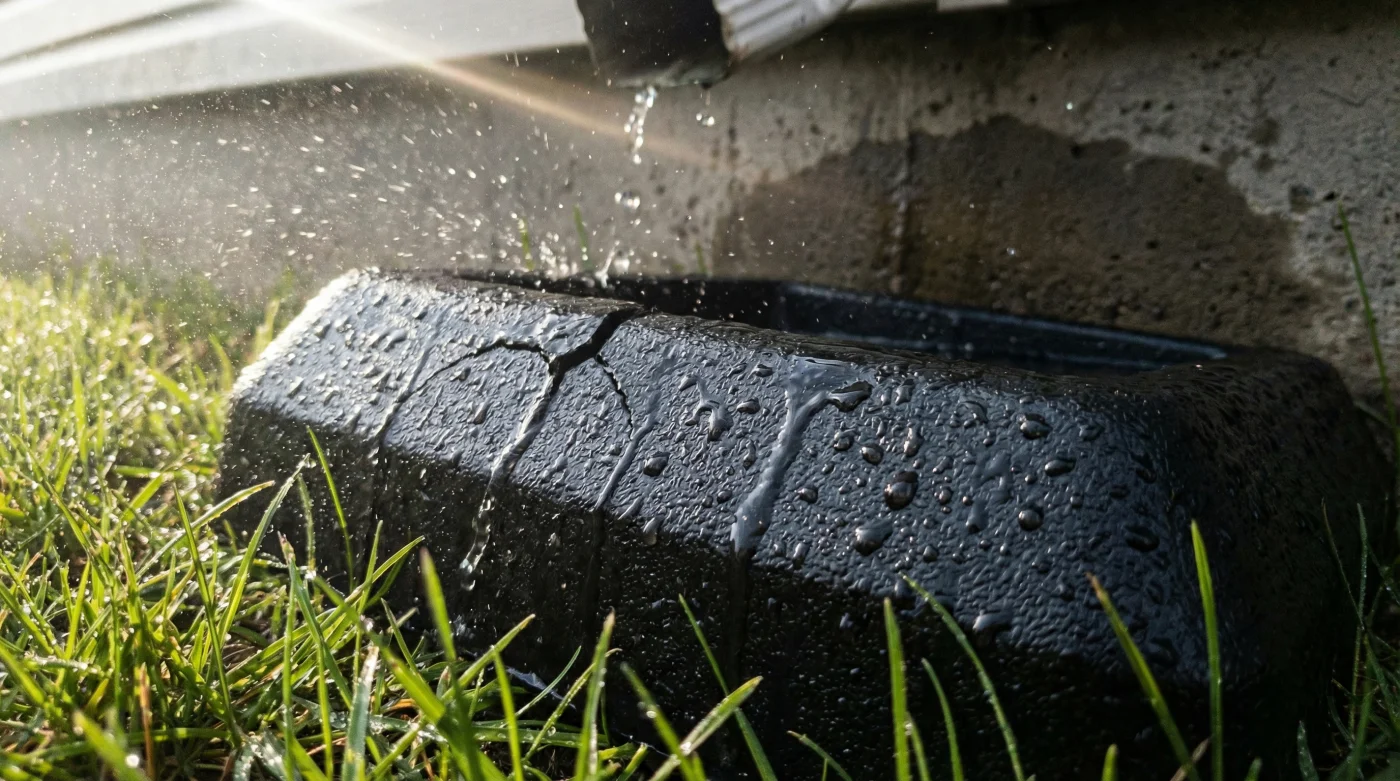
Picture a heavy April thunderstorm rolling through the suburbs. The air smells sharply of ozone and bruised wet grass, and the gutters are singing their metallic, rhythmic song. You watch the water rush out the bottom of the aluminum tube, assuming the system is working exactly as intended.
Yet, that steady stream is silently setting up a catastrophic failure. When rain drops straight from a standard downspout opening, it does not just flow away into the yard. It pools, sinking heavily into the soil directly against your foundation walls.
Most folks sleep well hearing gutters work, believing gravity finishes the job once water hits the grass. But an unguided downspout acts like a slow-motion drill bit, boring into the very earth holding up your home.
We trust the original builder’s setup, completely unaware that a five-minute, ten-dollar intervention separates a dry basement from a flooded nightmare. You can actually stop expensive foundation settling before the first hairline crack ever appears.
The Hydraulic Drill Hiding in Plain Sight
Think of the earth wrapping your basement like a massive, dense sponge. When you channel thousands of gallons of roof runoff into a single six-inch circle of dirt, that sponge becomes heavily saturated and exhausted.
It mimics the effect of breathing through a tight straw aimed directly at a sandcastle. The resulting hydrostatic pressure pushes against your concrete blocks with thousands of pounds of force, forcing moisture through microscopic pores.
The common myth dictates that standard downspouts are entirely sufficient to handle the heavy lifting of a storm. The reality is that an unguided spout merely transports the problem from your roof shingles down to your vulnerable basement perimeter.
This is where a mundane piece of molded plastic becomes your home’s most vital shield. By shifting the release point just three feet away from the wall, you completely neutralize the aggressive hydraulic threat.
Marcus Thorne, a 58-year-old structural engineer in Cleveland, spends his entire week inspecting compromised, shifting basements. He jokes that he can diagnose ninety percent of his clients’ foundation issues without ever going indoors. Before he even knocks on the front door, he checks the bottom of the gutters. He notes that if there is no diverter block kicking that water at least three feet into the yard, he already knows exactly where the basement wall is bowing. It is a quiet, shared secret among engineers that the best structural preservation costs less than a decent cup of coffee.
Recognizing this simple fact dramatically changes how you view a spring storm. Instead of worrying about the unseen subterranean forces shifting your house, you have absolute control over the outcome.
Adjusting the Flow for Your Terrain
Not every yard handles a heavy deluge the same way. The soil composition and the slope of your lawn heavily dictate how you should channel that aggressive runoff away from your house.
If you live on a completely flat lot, the pooling water has no natural escape route to follow. You will need a longer, low-profile splash block to aggressively push the moisture past the porous backfill zone surrounding your basement walls.
For a yard with a steep grade sloping away from the house, gravity is already your capable ally. A standard, slightly textured diverter will slow the water’s velocity so it does not brutally wash away your rich topsoil and fresh mulch.
Homes with dense, established garden beds hugging the perimeter require a slightly more delicate touch. You might use a hinged or flexible extension resting gently over the hostas, ensuring the delicate root systems are not drowned by the concentrated flow.
The Three-Foot Rule of Foundation Preservation
Fixing this vulnerability requires no heavy machinery, no loud power tools, and minimal physical effort. It is a quiet, mindful task you can easily complete on a peaceful Saturday morning before the neighborhood wakes up.
Your goal is simply to bridge the gap between the downspout and the solid, untouched earth. By executing a few deliberate, minimalist actions, you secure the perimeter of your home against the weather.
- Clear the soil directly under the downspout, removing loose rocks or soggy mulch to create a firm, level pad.
- Angle the ground away from the house at a slight downward pitch, dropping roughly one inch for every foot of distance.
- Place the diverter block snugly under the lip of the downspout, ensuring the water hits the center channel.
- Verify the block extends at least three feet from the foundation wall before depositing the water into the yard.
Gather your tactical toolkit for this straightforward weekend operation: one resin splash block, a simple hand trowel for leveling the soil, and a small torpedo level to guarantee a downward slope.
Once the blocks are perfectly set, you can watch the next storm with a deep sense of genuine satisfaction. You will see the rainwater safely gliding away downstream, leaving your foundation completely unbothered and perfectly intact.
Peace of Mind Measured in Inches
Maintaining a home often feels like a constant, weary battle against decay, rust, and natural entropy. But occasionally, the physical world offers a profoundly simple countermeasure to a massively complex structural problem.
Diverting the rain away from your foundation is not merely a chore on a weekend list; it is a vital act of preservation. It protects the quiet sanctuary of your home, keeping the air in your basement dry and the walls perfectly plumb.
You realize that true structural integrity does not always come from pouring thicker concrete or driving deeper steel piles into the bedrock. Sometimes, true strength simply comes from outsmarting gravity with a molded piece of plastic.
Next time the dark storm clouds gather and the heavy seasonal rains fall, step out onto your covered porch. Listen to the water safely leaving your property, knowing the foundation stands strong.
The easiest way to fix a flooded basement is to stop the water three feet before it ever reaches the wall.
| Key Point | Detail | Added Value for the Reader |
|---|---|---|
| Standard Spout | Drops water directly at the base of the wall. | Helps you identify the hidden cause of damp basement corners. |
| Diverter Block | Channels runoff at least 36 inches away. | Saves you thousands in concrete repair and mold remediation. |
| Proper Grading | Slopes the soil downward from the house. | Ensures the diverted water never flows back toward your footing. |
Frequently Asked Questions
Do I need a diverter if my gutters are clean? Yes. Clean gutters simply deliver the water to the foundation faster. The diverter moves it away from the structural danger zone.
How far should the splash block extend? Three feet is the absolute minimum distance to clear the porous backfill soil that rests against your basement walls.
Can I use a flexible pipe instead of a block? You certainly can, provided you bury it or angle it so water does not pool inside and freeze during colder months.
What if my yard slopes toward my house? You will need to re-grade the immediate three feet of soil to pitch away from the foundation before laying your diverter.
Are concrete blocks better than plastic? Concrete blocks stay in place during heavy winds, but plastic or resin blocks are much easier to move when mowing your lawn.