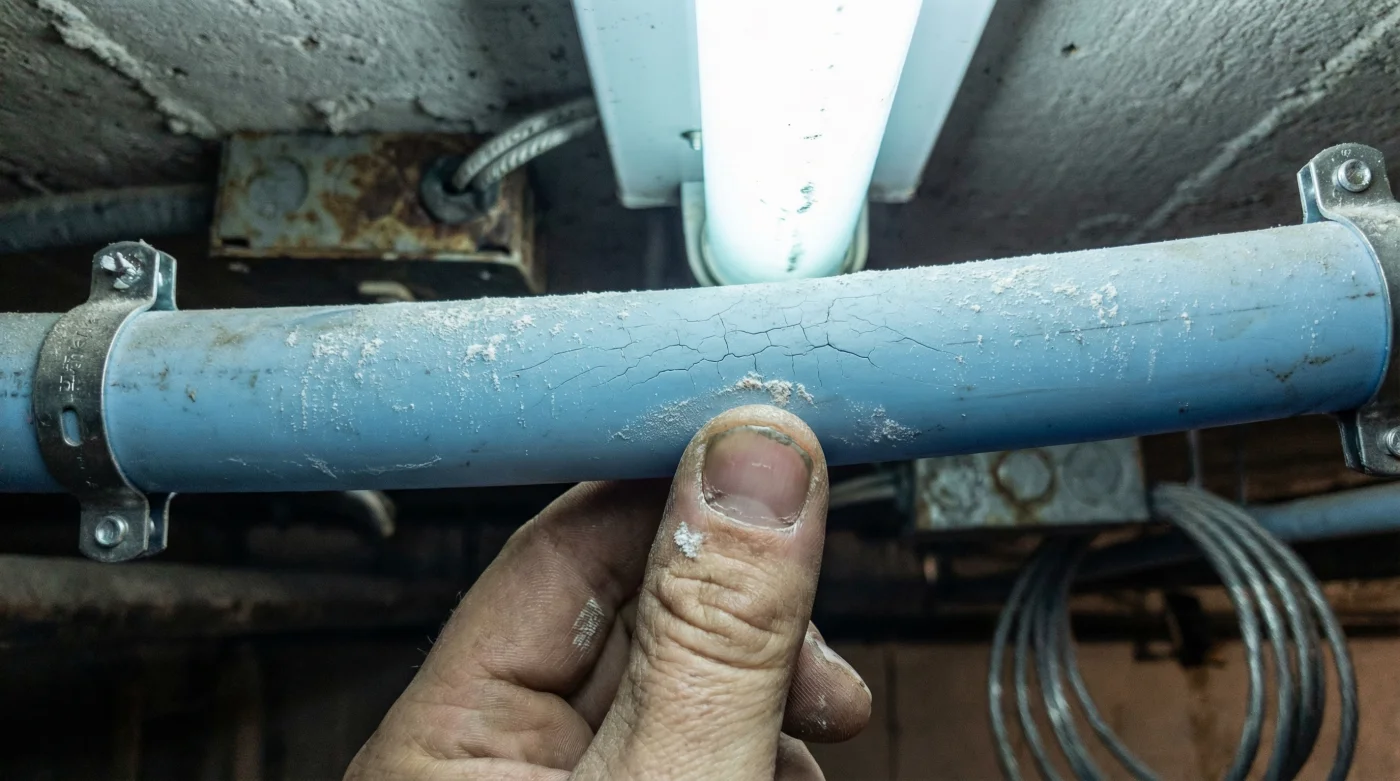
You flip the switch at the top of the stairs, and the basement flickers to life with the familiar, low hum of fluorescent shop lights. The air carries that faint, unmistakable scent of cool concrete and old cardboard boxes. You look up at the exposed floor joists, taking comfort in the neat rows of bright red and blue PEX piping tracing their way to your water heater. It feels like a modern fortress of plumbing. No copper to corrode, no PVC to shatter. But right under that bright white bulb, a slow, invisible breakdown is happening. You might notice the vivid blue color seems slightly muted compared to when it was first strung up, but you brush it off as mere dust. It is not dust. It is a molecular failure unfolding in slow motion.
The Silent Sunburn of Your Plumbing
We are taught to treat our homes like fortresses against the outside elements. You seal the windows against the winter draft and insulate the roof against the August heat. You likely assume that because your plastic water lines are indoors, they are safe from the elements. But the reality is much more subtle. PEX piping shares a vulnerability with human skin: it cannot handle ultraviolet light. The cross-linked polyethylene that makes up your piping is a marvel of modern engineering. It expands during a freeze rather than bursting, and it bends around corners like a heavy-duty garden hose. Yet, for all its resilience against pressure and temperature, it has a fatal flaw when it comes to the light spectrum.
Think of it as the sunburn of the basement. While you would never leave a spool of PEX sitting out in the driveway under the blistering July sun, you might not realize that the standard fluorescent bulbs illuminating your workbench are emitting a low-level, continuous stream of UV radiation. Over months and years, this relentless exposure attacks the molecular bonds of the polymer. The plastic loses its elasticity. What was once flexible and strong becomes brittle, chalky, and critically weak.
I learned this the hard way from David, a master plumber who spent three decades pulling miles of piping through old Boston rowhouses. We were standing in a damp cellar one November morning, looking at a pinhole leak that had completely ruined a finished drywall ceiling below. The pipe had not frozen, nor had it rubbed against a sharp joist nail. It was a straight section of red PEX suspended directly inches beneath a twin-tube fluorescent utility light. He reached up and ran his calloused thumb over the pipe, scraping off a fine, powdery residue that drifted down into the beam of his flashlight. ‘People think the sun stays outside,’ he told me, wrapping a temporary piece of rubber tape around the damage. ‘But a fluorescent bulb is just a little indoor sun. This plastic has been baking in the dark for four years. It was only a matter of time before it gave out.’
| Homeowner Profile | Specific Benefit of Intervention |
|---|---|
| The DIY Renovator | Preserves the integrity of newly installed plumbing, preventing costly rework. |
| The First-Time Buyer | Secures long-term peace of mind by eliminating a hidden flood risk before it happens. |
| The Basement Tinkerer | Allows you to keep bright workbench lighting without sacrificing utility lines overhead. |
When you understand the mechanical reality of this degradation, the necessity of a quick fix becomes obvious. It is not about a sudden, catastrophic burst that happens overnight. It is a slow, creeping structural fatigue. The pipe wall thins and hardens until it eventually yields to the constant 60 PSI of municipal water pressure pushing against it from the inside.
| Light Source | UV Emission Level | PEX Degradation Timeline |
|---|---|---|
| Direct Sunlight | Extreme | 30 to 60 days of continuous exposure |
| Standard Fluorescent Tube | Low to Moderate | 1 to 3 years of heavy daily use |
| LED Shop Light | Negligible | Indefinite (Structurally Safe) |
The Five-Minute Shielding Technique
Fortunately, halting this process does not require repiping your entire home or calling in an expensive professional crew. The solution is entirely physical, highly tactile, and surprisingly inexpensive. Master plumbers rely on a simple UV-blocking sleeve technique to protect vulnerable sections of pipe. You only need to address the specific areas directly exposed to the light path.
- R-410A refrigerant bans force homeowners into expensive full HVAC system replacements.
- New EPA gas stove regulations ban these standard residential burner models.
- Plastic drywall anchors fail immediately under continuous dynamic television mount weight.
- Tankless water heaters require this vinegar flush routine every six months.
- MERV 13 HVAC filters actively burn out older furnace blower motors.
The installation is incredibly satisfying. Gently pry open the slit in the foam and press it directly over the PEX. You will feel it snap into place, hugging the plastic tight like a protective jacket. For absolute protection, do not rely on the foam’s factory adhesive strip alone. The humidity in a basement will eventually cause that glue to fail. Instead, take a roll of aluminum foil HVAC tape and wrap a tight, restrictive band around the insulation every twelve to eighteen inches. The foil tape ensures the seam never separates under seasonal temperature changes from a freezing 30 degrees to a humid 90 Fahrenheit, sealing out the damaging light completely.
| Material Checklist | What to Look For | What to Avoid |
|---|---|---|
| Pipe Insulation | High-density, closed-cell polyethylene foam. | Thin, highly porous fiberglass wrapping. |
| Securing Tape | Aluminum foil HVAC tape with a strong acrylic adhesive. | Standard duct tape, which dries out and peels off easily. |
| Replacement Bulbs | LED tube replacements that bypass the ballast entirely. | High-output UV fluorescent grow lights or tanning bulbs. |
Restoring the Balance of Your Home
Taking a few minutes on a Saturday morning to sleeve your pipes does more than just prevent a flooded basement. It fundamentally changes how you interact with the hidden bones of your house. You are no longer just occupying a box of painted walls and hidden wires; you are actively caring for a complex, living system. By blocking out that silent, damaging light, you grant your plumbing the exact longevity it was engineered to have.
You can flip that basement switch on without a second thought. The bright, sterile glow of the workbench lights will still illuminate your tools and projects, but the fragile polymer overhead will remain safely shielded in the dark. It is a small, quiet victory of home maintenance. You are putting a simple physical barrier between your infrastructure and the elements, keeping the water flowing exactly where it belongs. That is the true essence of an expertly maintained home.
The best plumbing repairs are the ones you make five years before the leak ever happens.
Frequently Asked Questions
Can I just paint the PEX pipe to block the UV light?
Never paint PEX. The solvents in most aerosol and latex paints will chemically degrade the plastic even faster than the UV light.Do LED lights cause the same damage to PEX?
No. LED lights do not emit the damaging UV spectrum that breaks down polymer bonds, making them a perfectly safe alternative.How do I know if my PEX is already damaged?
Turn off the light and shine a flashlight closely at the pipe. If the color looks faded, chalky, or powdery to the touch, the degradation has begun.Does window sunlight in a basement have the same effect?
Yes. Any natural sunlight passing through a basement window carries high levels of UV and will degrade exposed PEX very rapidly.Will the foam insulation cause the cold water lines to sweat?
Actually, the opposite. The closed-cell foam prevents condensation from forming on cold lines during humid summer months, acting as a double benefit.